It’s so hard to believe that Intelligent Compaction is 50 years old (1976-2026)! Intelligent Compaction (IC) was a revolutionary technology that turned construction machines into “measurement devices” to help monitor and control compaction during construction, not after the fact. IC later inspires other intelligent construction technologies and then gives rise to the International Society for Intelligent Construction (ISIC) to integrate all innovative technologies, enabling us to design, build, and manage transportation infrastructure more “intelligently” – improving quality, efficiency, and safety. ISIC will celebrate “IC 50” with a series of articles (IC-50 posts) and activities (2026 ISIC North American Conference and ISIC International Conference). Please join us at ISIC to celebrate the contribution of IC for the past 50 years!
50th Anniversary of Intelligent Compaction
2026 MTCE ISIC Track Report Published
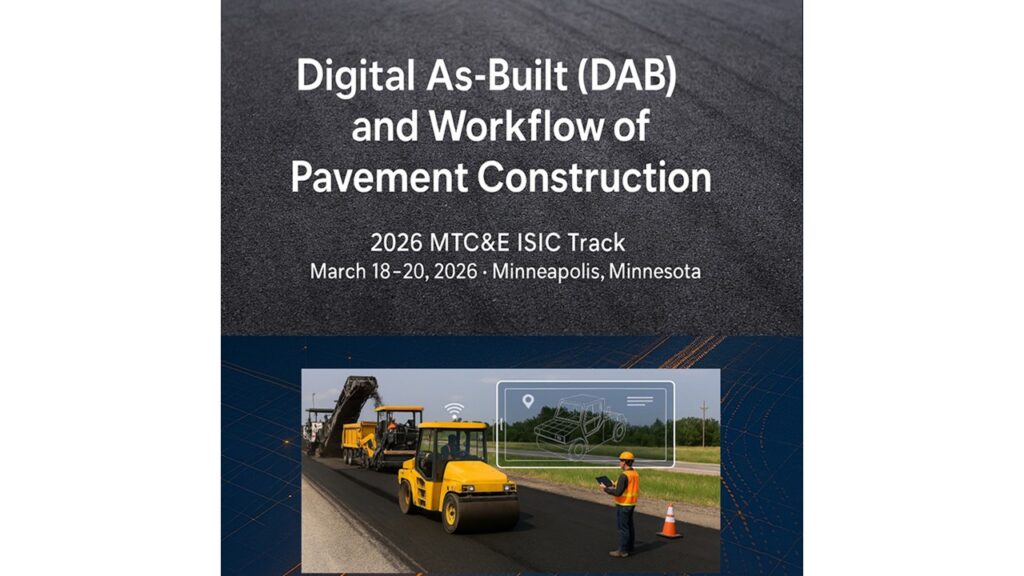
The International Society for Intelligent Construction (ISIC) just published the 2026 MTCE ISIC Track Report. Please click the link to download the summary report. The following is the Executive Summary:
The International Society for Intelligent Construction (ISIC) North America Chapter sponsored a dedicated technical track at the 2026 Minnesota Transportation Conference and Expo (MTC&E), held March 18–20, 2026, in Minneapolis, Minnesota. The one‑day ISIC Track focused on Digital As‑Built (DAB) technologies and pavement construction workflows, bringing together public agencies, contractors, technology providers, and consultants to examine current practices, emerging solutions, and implementation lessons across the pavement life cycle.
The ISIC Track addressed the growing need for accurate, interoperable, and actionable construction data to support quality construction, effective contract administration, and long‑term asset management. Presentations highlighted how modern construction equipment, sensing technologies, and digital delivery platforms can automatically capture as‑built data during milling, paving, compaction, and material delivery operations. Emphasis was placed on integrating these data streams into agency systems to improve decision‑making, documentation, and lifecycle management.
Key technical sessions explored DAB workflows derived from Material Delivery Management Systems (MDMS), 2D and 3D machine guidance for milling and paving, paver‑mounted thermal profiling, intelligent compaction, and the development of “living models” that connect construction as‑builts with asset and pavement management systems. Case studies demonstrated how these technologies are being applied in practice to enhance quality control and quality assurance (QC/QA), diagnose construction issues, support payment accuracy, and improve finished pavement performance.
The track also examined organizational and contractual considerations necessary for successful implementation, including digital scoping, project‑specific electronic data, model requirements, data standards, and interoperability among equipment and software platforms. Agency perspectives, particularly from the Minnesota Department of Transportation (MnDOT), provided insight into current deployment strategies, implementation challenges, and planned transitions toward more comprehensive DAB requirements.
The ISIC Track concluded with an open panel discussion featuring representatives from transportation agencies, contractors, equipment manufacturers, and consultants. The discussion reinforced the importance of collaboration, standardized workflows, and workforce readiness in advancing intelligent construction practices. Panelists emphasized that Digital As‑Built data are no longer optional add‑ons but foundational components of modern pavement construction and management.
This report documents the ISIC Track agenda, abstracts, speaker contributions, and key discussion themes. It serves as a reference for transportation agencies, industry practitioners, and researchers seeking to better understand current DAB capabilities, implementation pathways, and opportunities to improve pavement construction quality, efficiency, and long‑term asset performance through intelligent construction technologies.
Intelligent Compaction Book Published
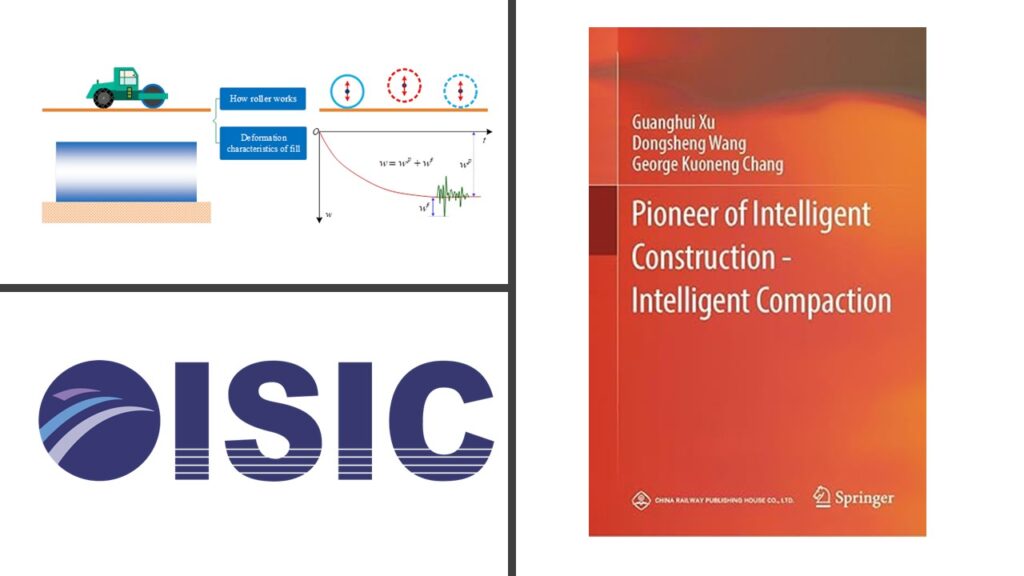
The ICT Book Series No. 2: “Pioneer of Intelligent Construction – Intelligent Compaction” is officially published by Springer Nature Publisher.
Background
In a critical period of digital transformation for the traditional infrastructure industry, intelligent compaction (IC) technology, with its complete “perception-analysis-decision-execution” closed loop, is redefining the quality control paradigm for subgrade, subbase, and pavement construction. As the “fourth revolution in road construction technology,” intelligent compaction has evolved from theory to a practical field solution in the past 40-plus years. The book “Pioneer of Intelligent Construction: Intelligent Compaction,” written by IC experts Guanghui Xu, Dongsheng Wang, and George K. Chang, provides a systematic, in-depth account of this journey. This book is also the second in the “Intelligent Construction Technologies for Transport Infrastructure – A Book Series” from the International Society for Intelligent Construction (ISIC), following the first, “Introduction to Intelligent Construction Technologies for Transport Infrastructure”, published in 2022.
This book breaks away from the typical technical book framework, using the core logic of intelligent construction as its main thread. Starting with the basic characteristics of fill engineering, the discussion gradually unfolds into the theoretical system of intelligent compaction, implementation methods, and prospects. It is not only an introduction to IC but also an in-depth explanation of the entire ICT framework and its inherent characteristics. Thus, as the book title suggests, IC serves as a pioneer in intelligent construction technologies.
Using modulus/stiffness as the control index, the book not only clarifies the generational differences between continuous compaction and intelligent compaction but also deeply analyzes key technical aspects, including mechanical mechanisms, sensor testing, intelligent modeling, and feedback control during compaction.
Particularly valuable is the authors’ discussion, both in the main body text and appendices, of the technical requirements and coordination methods for the three major control elements: compaction degree, compaction stability, and compaction uniformity based on three decades of research and field experience. They provide a complete implementation path and real-world case studies, allowing readers to clearly understand the entire process from IC system setup to on-site implementation. In addition, the book presents several extended applications of intelligent compaction. The appendix not only answers common problems encountered in practice but also provides a detailed discussion of the technical classification of Intelligent Compaction technologies.
About the Authors
Prof. Guanghui Xu, Ph.D., has worked in railway design and research institutes in the early days. He later joined Harbin Institute of Technology and other universities to engage in scientific research and teaching. His research interests include road and railway engineering dynamics theory, testing and information analysis technology, and intelligent technology applications. Prof. Xu is the co-founder of ISIC. He has consistently adhered to the principle of paying equal attention to theoretical and applied research and to practical results. He has organized and led a multidisciplinary scientific research team and carried out long-term, independent research and development of intelligent construction monitoring technology. Prof. Xu also produced a series of research results with intellectual property rights. In 2011 and 2017, he oversaw the development of China’s first industry construction standards and product standards for intelligent compaction (IC) technology.
Prof. Dongsheng Wang, Ph.D., is a Road and Railway Engineering Department professor at Harbin Institute of Technology, China. Prof. Wang is also an ISIC Steering Committee member and a member of the Heilongjiang Youth Federation. His primary research areas include pavement mechanics, structural design theory, pavement materials, and constitutive models. He has led over nine projects, including those funded by the National Natural Science Foundation of China, and won the second prize of the Jilin Province Science and Technology Progress Award and the first prize of the China Highway Society Science and Technology Award. Prof. Wang has contributed to the development of many industry standards. He was selected for Harbin Institute of Technology’s top-notch teaching talent program.
George K. Chang, Ph.D., P.E., is a world expert on pavement smoothness and intelligent compaction/construction technologies. Dr. Chang co-founded ISIC and has served as its president since 2016. His research, teaching, specification development, and software tools have helped make significant technological advancements in the above fields. The websites he develops and maintains, Profile Viewing and Analysis—ProVAL (www.RoadProfile.com) and Intelligent Construction Technologies & Veta software (www.IntelligentConstruction.com), have evolved into the one-stop shop for pavement smoothness and intelligent compaction/construction. He has been leading the International Roughness Index (IRI) US national deployment effort with ProVAL since 2001, and the intelligent compaction research and implementation effort with Veta since 2007.
The authors have combined more than 70 years of IC research, education, software development, and practical application across various projects worldwide, making this book both theoretically profound and practically insightful. The methods described in the book have all been validated in hundreds of field engineering projects worldwide and are highly practical and implementable.
Target Audience
This book targets the following readers:
- Engineering technicians and managers: Systematically master intelligent compaction implementation methods and quality control key points.
- Engineering machinery R&D teams: Gain a deep understanding of the theoretical basis and interaction logic of intelligent equipment.
- University teachers and students: Obtain cutting-edge and systematic teaching and research reference materials in the field of intelligent construction.
- Industry decision-makers and planners: Gain insights into road construction technology development trends and industrial upgrading paths.
The book uses clear, concise language and is richly illustrated, making it easy to read, even for engineers without a background in intelligent construction technologies. Therefore, this book is truly practical work, “derived from engineering and applied to engineering.”
ICT Book Series Overview
This book is a part of the “Intelligent Construction Technologies for Transport Infrastructure – A Book Series,” a seven-volume series. This book series comprehensively constructs a knowledge system for intelligent construction, spanning theoretical frameworks, sensing foundations, analysis and decision-making, and execution and control. The other volumes are:
- Introduction to Intelligent Construction Technologies for Transportation Infrastructure
- The Foundation of Sensing Methods: One-Dimensional Dynamics and Applications in Engineering
- The Foundation of Machine Analysis and Decision-Making: A Journey into Machine Learning
- A Powerful Tool for Engineering Quality: Sensing and Data
- The Assistant for Execution: Control Technology in Engineering
This book series is jointly authored by a team of experts from the International Society for Intelligent Construction (ISIC). With both Chinese and English versions released, it aims to provide systematic intellectual tools and practical references for the intelligent transformation of the transportation infrastructure industry.
In today’s construction industry, moving towards “smart+” technologies, this book, “Pioneers of Intelligent Construction: Intelligent Compaction,” not only presents a key technology but also demonstrates a systematic transformation in the engineering paradigm. It is a valuable resource for every technical professional committed to advancing the industry, serving as both a real-time reference tool and a window into future technological innovation.
Publication Information
Both the English and Chinese versions of this book are now available on e-commerce platforms and through the publisher’s official channels. Please note that the book’s appendices differ slightly. The English version expanded the Q&As and added another one for the technical classification of IC.
English Version
- Title: Pioneers of Intelligent Construction: Intelligent Compaction
- Authors: Guanghui Xu, Dongsheng Wang, and George K. Chang
- Format: Hardcover
- Publisher: Springer Nature
- Publication Date: 2026-01-09
- ISBN: 978-9-819-54183-6
- Page Count: 203 pp
- Channels: Available on e-commerce platforms and through the publisher’s official channels: Springer Nature Publisher, Amazon online bookstore, Barnes and Noble online bookstore, Walmart online bookstore, ThriftBooks online bookstore
Chinese Version
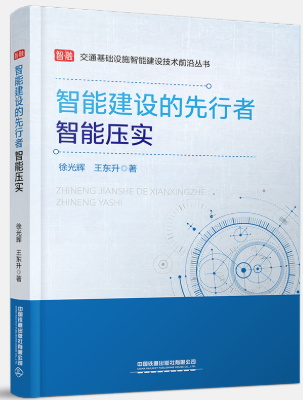
- Title: 智能建设的先行者:智能压实
- Authors: 徐光辉, 王东升 著
- Publisher: 中国铁道出版社
- Publication Date: August 2025
- ISBN: 978-7-113-32476-6
- Page Count: 188 pp
- Channels: Available in bookstores, on e-commerce platforms, and through the publisher’s official channels.
- 图书商城-中国铁道出版社有限公司 (China)
- 三民網路書店 (Taiwan)
iHEEP ISIC Workshop on Oct. 6, 2025

The International Society for Intelligent Construction (ISIC) will host a workshop titled “Digital Workflow from Design to Construction for Pavements” at the iHEEP 2025 conference (66th International Highway Engineering Exchange Program conference) in Myrtle Beach, SC, from October 5 to 10, 2025. The agenda is as follows:
Monday (October 6th, 2025) PM (EST)
| Time | Topic | Speakers |
| 3:00 PM | Introduction | Dr. George K. Chang (Transtec Group, A Terracon Company) |
| 3:00 PM – 3:25 PM | 1 – Milling and Pavement Equipment and the Use of 3D Models | Laikram Narsingh (John Deere Wirtgen Group); Jim Preston (TOPCON) |
| 3:25 PM – 3:50 PM | 2 – Geometric and Material As-Built Data Collected by Road Construction Equipment | Laikram Narsingh (John Deere Wirtgen Group); Jim Preston (TOPCON) |
| 3:50 PM – 4:15 PM | 3 – Living Models in Asset and Pavement Management Systems with Updates from Machines | Chuck Hixon (Matt McDonald); Tim Kowalski (John Deere Wirtgen Group) |
| 4:15 PM – 4:45 PM | 4 – Agency’s Perspective | Rebecca Embacher (MnDOT) |
| 4:45 PM – 5:00 PM | 5 – Contractor’s Perspective | Scott Fernald (Granite Construction) |
| 5:00 PM | Adjourned |
Detailed abstracts for each workshop session, along with speakers’ bios, can be downloaded here. Please register for iHEEP 2025 and reserve your seats for this fantastic workshop now!
BCRRA 2026 Calls for Abstracts

The 12th International Conference on Bearing Capacity of Roads, Railways, and Airfields (BCRRA 2026) will be held from 22 to 24 June 2026. The abstract submission will be due on June 9, 2025. We would like to kindly invite you to submit your contributions!
BCRRA 2026 is the twelfth edition of a prestigious conference held every four years since it began in 1982 in Trondheim. The conference focuses on the bearing capacity of transportation infrastructure, including roads, railways, and airports, as well as the latest developments in the field. BCRRA is well known for advancing knowledge and best practices in the design, construction, maintenance, and assessment of transportation infrastructure. BCRRA 2026 Main Themes [HERE].
Important dates:
- The deadline for abstract submission has been extended to June 9, 2025!
- Notification of Acceptance: June 30, 2025
- Full Paper Submission Deadline: September 8, 2025
Submission and Review Process:
- We offer two submission options: Full Paper (3–8 pages) published in the Transportation Research Procedia – open access (Elsevier), and an Extended Abstract (2–3 pages) for overviews or practical insights, published by the conference organizer.
- All submissions will undergo a two-stage double-blind peer review to ensure the highest level of academic and professional quality.
Submit your abstract [HERE].
For inquiries, contact the Conference Secretariat at info@bcrra.si.
We look forward to your contributions and to welcoming you to BCRRA 2026!
With kind regards,
BCRRA 2026 Organizing Committee
ISIC MDMS Webinar Recording Posted

We hosted an engaging ISIC Webinar 006 on April 16, 2025, titled “How Material Delivery Management System (MDMS) Enhances Paving Quality.” The MDMS standardizes data management for material delivery in paving contracts, encompassing source (E-Ticket), loading, delivery, testing, contract administration, agency field verification, and hauler processes. This webinar explored the AASHTO MDMS standard and its implementation through Veta—MDMS.
Moderated by Dr. George Chang of Transtec Group (A Terracon Company), the two-hour session featured key insights from industry experts. Rebecca Embacher of MnDOT introduced the AASHTO MDMS standard, Veta MDMS as a national platform, its data flow, and the user-friendly “wizard” feature. She also shared case studies on pavement construction forensics and updates on Veta MDMS pilot projects and rollout plans. Curt Dunn of NDDOT detailed his agency’s field experiences, recent projects, and future aspirations for Veta. Brent Carron of Valley Paving, representing contractors, discussed practical MDMS applications, benefits, challenges, and his vision for improvements.
The Q&A and panel discussion, joined by Monica Jurado of FHWA and Jim Hutchings of Fleetwatcher/AlignOps, addressed industry challenges, technical solutions, future Veta funding, enhancements, and outreach strategies for agencies and industry stakeholders.
Watch the full webinar recording. Join ISIC as a member for free access to all webinars, conference presentations, and reports.
IC for Pavement Foundation Update
The Transtec Group, A Terracon Company, Advances Intelligent Compaction Research with New FHWA Tech Brief and Ongoing Projects
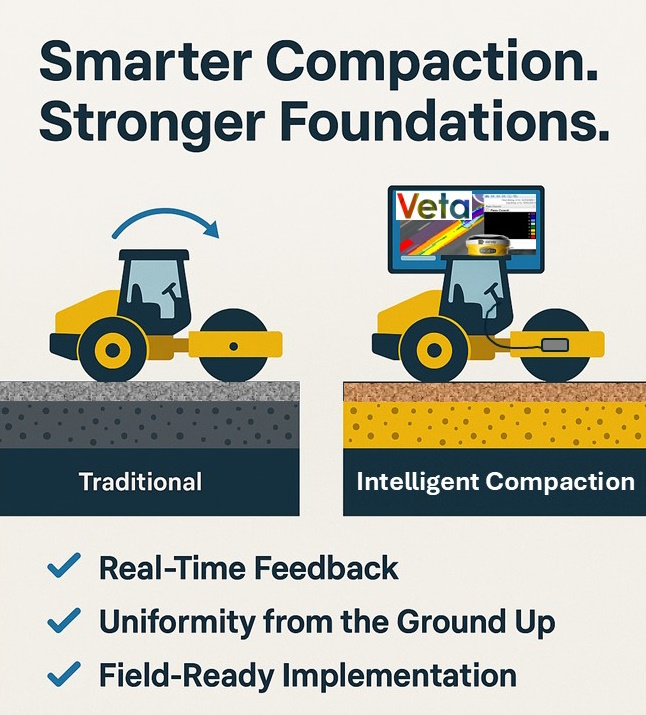
Austin, TX — The Federal Highway Administration (FHWA) has released a new Tech Brief on Intelligent Compaction (IC) for pavement foundations, authored by The Transtec Group, A Terracon Company. Titled Feasibility of Utilizing Intelligent Compaction Equipment to Ensure Uniformity and Quality of Pavement Foundation (FHWA-HIF-24-097), this concise publication summarizes a four-year research initiative focused on enhancing pavement foundation quality through advanced IC technologies.
This study highlights IC’s potential to improve the uniformity and adequacy of pavement foundations—beginning at the subgrade level—by enabling real-time adjustments during construction. The report also introduces a practical, field-friendly procedure for incorporating IC into full-scale infrastructure projects. The Tech Brief is available for download on the FHWA website.
A related presentation, delivered to the National Road Research Alliance (NRRA) Intelligent Construction Technology (ICT) team, can also be downloaded from the ICT website.
In tandem with the FHWA project, the research team has published a complementary report titled Evaluation of Levels 3-4 Intelligent Compaction Measurement Values (ICMV) for Soils Subgrade and Aggregate Subbase Compaction. This two-year NRRA study explores more advanced IC measurement techniques. A recorded webinar discussing its findings is available through the NRRA’s Research Pays Off webinar series.
Building on this research, The Transtec Group has initiated a new two-year collaboration with the Missouri Department of Transportation (MoDOT), running from 2025 to 2027. Titled Piloting the Use of Intelligent Compaction for Evaluating Pavement Subgrade Uniformity and Adequacy, this project aims to pilot IC technologies as a quality assurance (QA) tool for subgrade evaluation in state-level construction projects. Applications will include new roadway construction, lane widening, and full-depth repairs—further validating the feasibility and effectiveness of IC for broader adoption.
Dr. George Chang, the principal investigator for these research efforts, will co-author a forthcoming book titled Pioneer of Intelligent Construction: Intelligent Compaction. As the second volume in the ISIC ICT book series, the publication—set for release by Springer in late 2025—will offer a comprehensive look into IC, from fundamental mechanistic concepts to real-world field applications. Additional details are available on the ISIC publications webpage.
First conceptualized in 1978, Intelligent Compaction has remained at the forefront of construction innovation for nearly five decades. While recent developments have largely focused on asphalt applications, current research is bringing IC back to its roots—enhancing soils and subbase compaction to improve pavement foundation performance.
For more information or inquiries, please contact Dr. George Chang at GKChang@TheTranstecGroup.com, or reach out to The Transtec Group’s research team.
FHWA ICT for Asphalt Paving Virtual Workshops – Parts I & II

FHWA will conduct two-part (2-hour each) virtual workshops on Intelligent Construction Technologies (ICT) for Asphalt Paving on March 18 and 20, 2025. This workshop is sponsored by FHWA Project HIF230086PR project “Develop Informational Materials NDT Intelligent Construction Technologies for Asphalt Pavement during Construction”. The objectives of this workshop are to: Share ICT implementation strategies to improve quality, safety, asset management/performance, and to reduce costs; Overview of non-destructive testing and intelligent construction technologies for asphalt paving; Summarize Paver-mounted Thermal Profiles (PMTP), Intelligent Compaction (IC), Dielectric Profile System (DPS), and Veta ICT data management software: capabilities, shortfalls, and appropriate usage. Contractors, FHWA and DOT agencies, consultants, and academics who are interested in implementing ICT on asphalt paving projects to improve the construction quality are strongly encouraged to attend this informative workshop. All attendees will receive workshop certificates with 2 units of PDH or 0.2 units of CEU for completing each virtual workshop (NB: requires separate registrations).
Part I: Introduction to ICT, PMTP, and IC. March 18 (11:00 AM to 1:00 PM US EST) Registration Link. Download flyer.
Part II: DPS, Veta, and Implementation. March 20 (11:00 AM to 1:00 PM US EST) Registration Link. Download flyer.
ISIC Webinar on MDMS

The International Society for Intelligent Construction (ISIC) will conduct the Webinar Series No. 006: How Material Delivery Management System (MDMS) Benefits Paving Quality from 9 AM to 11 AM US CST on Wednesday, April 16th, 2025. Please register and reserve your seat by clicking the link (Registration is free)!
Material delivery management system (MDMS) is a standardization effort to manage all data associated with the delivery of material to a paving contract, including Source (E-Ticket), Loading and delivery event, Testing and contract administration, Agency field verification, Hauler. This webinar will provide the background of the AASHTO MDMS standard and Veta—MDMS implementation. Speakers from the Department of Transportation (DOT) and contractors will also share their perspectives and demonstrate case studies on how MDMS helps them leverage the values of all intelligent construction technologies to diagnose paving issues and make timely corrective actions to improve pavement qualities. We will also have a panel discussion that includes all speakers, FHWA, and vendors’ representatives.
FREE Hybrid ICT workshop for Asphalt Paving

Due to a high demand, we decided to make this workshop in HYBRID! A FREE Intelligent Construction Technologies (ICT) for Asphalt Paving Workshop will be conducted at the 52nd Annual Rocky Mountain Asphalt Conference & Equipment Show (RMACES) Conference AND broadcasted via GotoWebinar from 8AM to noon, mountain time, on Thursday, February 20, 2025. The physical workshop location is at Marriott Denver Tech Center (4900 S Syracuse St, Denver, CO 80237), Room Iris, Blue Bell, or Lupine. This workshop is sponsored by FHWA Project HIF230086PR project “Develop Informational Materials NDT Intelligent Construction Technologies for Asphalt Pavement during Construction”.
The objectives of this workshop are: Share ICT implementation strategies to improve quality, safety, asset management/performance, and to reduce costs; Overview of non-destructive testing and intelligent construction technologies for asphalt paving; Summarize Paver-mounted Thermal Profiles (PMTP), Intelligent Compaction (IC), Dielectric Profile System (DPS), and Veta ICT data management software: capabilities, shortfalls, and appropriate usage. Contractors, FHWA and DOT agencies, consultants, and academics who are interested in implementing ICT on asphalt paving projects to improve the construction quality are strongly encouraged to attend this informative workshop.
This workshop is FREE for all. Registration methods:
- On-site, In-Person: Please click here to sign up.
- Remote: Please click here to sign up for the remote GotoWebinar option.
Download Veta
Veta is a map-based tool for viewing and analyzing geospatial data. Download Veta for free.
